Most developers know the OWASP Top 10, but fewer know MITRE ATT&CK. OWASP tells you what can break. ATT&CK tells you how attackers actually operate. Together, they give you a complete picture of application security.
I’ll be presenting this topic at NDC Security 2026 in Oslo, March 2-5. If you’re attending, come check out my talk — MITRE ATT&CK for Developers — on Wednesday, March 4 at 10:20.
The Security Challenge#
Modern applications have a massive attack surface — APIs, microservices, cloud resources — every one a potential entry point. Attackers chain multiple techniques across stages, adapting as they go. Traditional defenses focus on single points of failure, but sophisticated attacks slip through.
The uncomfortable truth: attackers iterate faster than our defenses.
What is OWASP#
OWASP is a community-driven organization that publishes security standards for web applications. The OWASP Top 10 catalogs the most critical risks:
| # | Category |
|---|---|
| A01 | Broken Access Control |
| A02 | Cryptographic Failures |
| A03 | Injection |
| A04 | Insecure Design |
| A05 | Security Misconfiguration |
| A06 | Vulnerable and Outdated Components |
| A07 | Identification and Authentication Failures |
| A08 | Software and Data Integrity Failures |
| A09 | Security Logging and Monitoring Failures |
| A10 | Server-Side Request Forgery (SSRF) |
OWASP’s strength is prevention — it tells you what vulnerabilities exist and how to fix them.
What is MITRE#
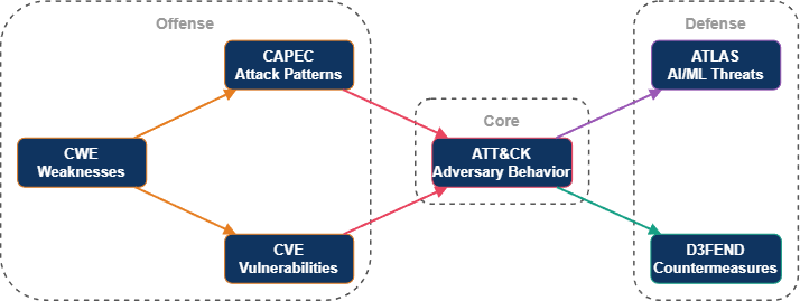
MITRE is a not-for-profit, vendor-neutral organization founded in 1958. They maintain an ecosystem of interlocking cybersecurity frameworks:
- CVE - catalogs specific vulnerabilities in software
- CWE - classifies underlying weakness types in code
- CAPEC - documents attack patterns
- ATT&CK - maps real-world adversary behavior
- D3FEND - catalogs defensive countermeasures
- ATLAS - covers AI and machine learning threats
What is MITRE ATT&CK#
MITRE ATT&CK (Adversarial Tactics, Techniques, and Common Knowledge) is a knowledge base of adversary behavior based on real-world cyber attacks. Born from a 2013 experiment at Fort Meade, it catalogs what attackers actually do across the full attack lifecycle.
The Enterprise Matrix has 14 tactics, over 200 techniques, and 400+ sub-techniques.
How It Is Organized#
- Tactics - the “why” (the adversary’s goal)
- Techniques - the “how” (the method used)
- Sub-techniques - specific implementations
- Procedures - real-world examples from threat actors
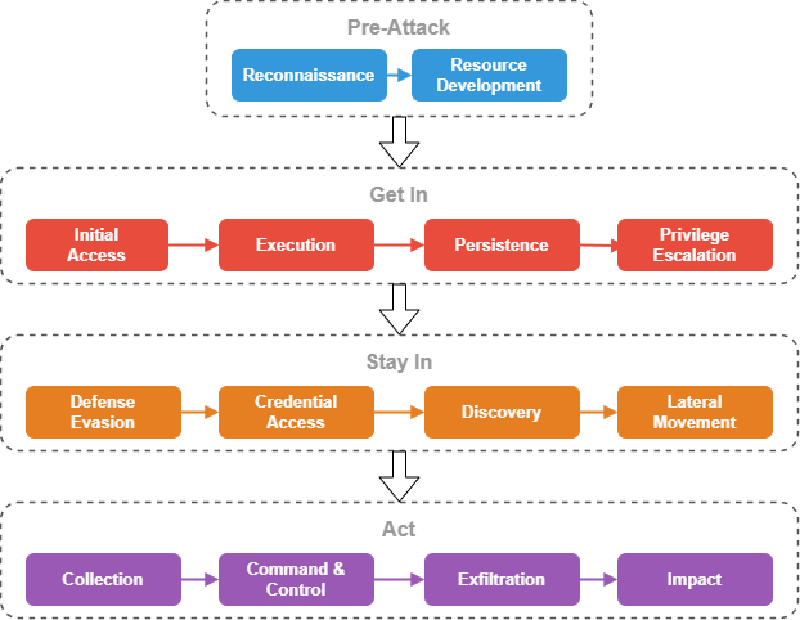
The 14 Tactics#
| Phase | Tactics |
|---|---|
| Pre-Attack | Reconnaissance, Resource Development |
| Get In | Initial Access, Execution, Persistence, Privilege Escalation |
| Stay In | Defense Evasion, Credential Access, Discovery, Lateral Movement |
| Act | Collection, Command and Control, Exfiltration, Impact |
OWASP vs ATT&CK: Why You Need Both#
These frameworks are complementary, not competitive:
| OWASP | MITRE ATT&CK | |
|---|---|---|
| Focus | Vulnerabilities | Adversary behavior |
| Perspective | What breaks | What attackers do |
| Approach | Prevention-first | Detection-oriented |
| Scope | Application layer | Full attack lifecycle |
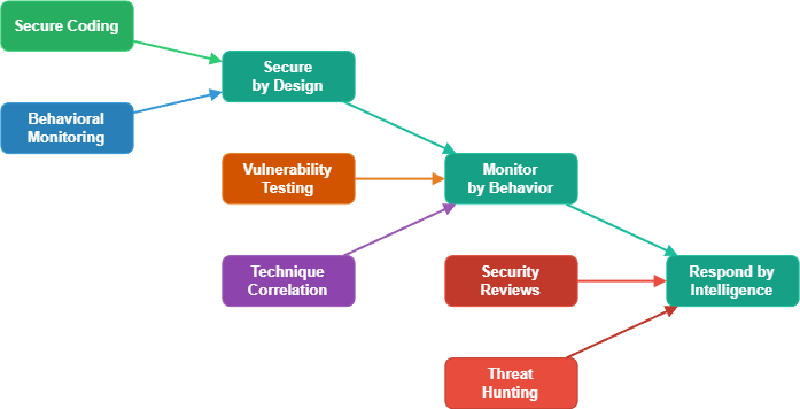
“OWASP prevents vulnerabilities. ATT&CK detects adversary behavior.”
A single OWASP vulnerability can enable multiple ATT&CK techniques:
| OWASP Category | ATT&CK Techniques |
|---|---|
| Broken Access Control | T1078 (Valid Accounts), T1098 (Account Manipulation), T1068 (Privilege Escalation) |
| Injection | T1190 (Exploit Public-Facing App), T1059 (Command Injection) |
| Security Misconfiguration | T1552 (Unsecured Credentials), T1082 (System Info Discovery) |
| Cryptographic Failures | T1555 (Credentials from Password Stores), T1565 (Data Manipulation) |
| Authentication Failures | T1087 (Account Discovery), T1110 (Brute Force) |
Why Developers Should Care#
You already use MITRE data. Tools like Dependabot, Snyk, and Trivy report CVEs and CWEs under the hood. Understanding the ecosystem helps you make better decisions about what to fix and why.
Shared vocabulary. When your SOC team says “we detected T1190,” you’ll know they mean exploitation of a public-facing application and can reason about which services might be affected.
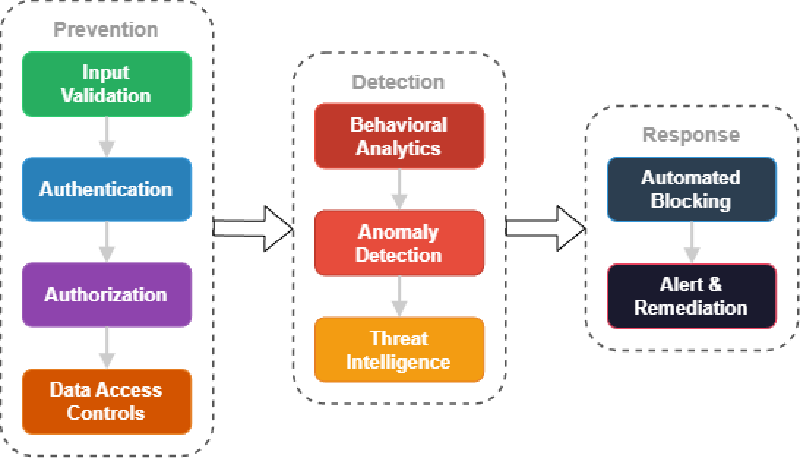
Your code is the detection layer. The logs and telemetry you emit feed directly into ATT&CK-based detection systems. Better observability means faster threat detection.
Attack Chains Are Real#
Attackers chain multiple techniques together. A supply chain attack might unfold like this:
- Attacker publishes a typosquatted npm package
- Post-install script executes a payload
- Payload harvests credentials from environment variables
- Stolen credentials provide production access
- Attacker creates a backdoor IAM user for persistence
- Customer data is exfiltrated

Six techniques, six tactics, one continuous attack. Defend only at the perimeter and you miss five of six detection opportunities. Real attacks also loop and backtrack — ATT&CK captures this reality with a matrix rather than a linear chain.
What You Can Do Today#
Start with three high-impact techniques:
- T1078 - Valid Accounts — monitor authentication patterns for credential stuffing
- T1539 - Steal Web Session Cookie — secure session management with fingerprinting and short expiration
- T1213 - Data from Information Repositories — behavioral analytics to detect unusual data access
Then build from there:
- Map features to techniques — identify which ATT&CK techniques each feature could enable
- Tag logs with technique IDs — so your SIEM can correlate events
- Use the ATT&CK Navigator — visualize coverage and gaps
- Include ATT&CK in threat modeling — consider how attackers would chain techniques
- Review code for both — OWASP vulnerabilities AND technique resistance
Resources#
Conclusion#
OWASP and ATT&CK are two sides of the same coin — prevent what you can, detect what you cannot. Understanding how attackers operate makes you a better developer. Start small, pick a few high-impact techniques, and build from there.