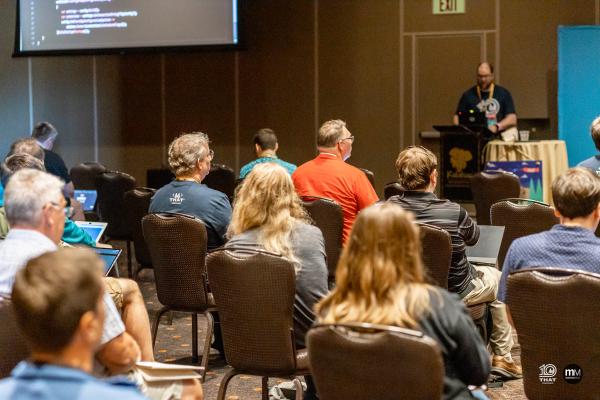
Presenting and speaking are skills that require practice to hone. I was a consultant for many years presenting to clients and customers of all levels and sizes. In addition, I started speaking and presenting at meetups, user groups, and conferences. Over the years, I practiced, I read, and I gave a lot of presentations. I’d like to share some of the learnings and best practices I’ve found in that time. I plan multiple posts, starting with Preparation. I’ll have more on slide design, and presentation tips.
A common issue I see when discussing DevOps with teams or organizations is the presence of Organizational Silos. Organizational Silos are made up of all types of people. Sometimes its a job type, like developers, qa, or infrastructure. Sometimes its a department, like accounting, or hr. Whatever the composition of these silos, they usually impact organizational performance and the ability to deliver value to end users.
This happens over time, with members of the silo identifying with each other, viewing those not in the silos as outsiders. Depending on the business, the silos can lose trust in the business overall and tighten ranks around their silo. The silos can turn into walled fortresses. When the silos get in the way, the silos are more focused on their own success than the success of the organization.
I’m presenting soon on Advanced Git. I feel a lot of Developers and DevOps engineers know enough git to the job, but sometimes that’s it. I want to help people be more comfortable with the git command-line, and help alleviate some fear or hesitation in dealing with git edge cases.
While researching things, I came across a few neat tools I’m using to help describe things.
This blog was posted as part of the Third Annual C# Advent. Make sure to check out everyone else’s work when you’re done here
Dependency Injection, or DI, is a Software Architecture Design Pattern. DI is something that comes up during discussions on SOLID, IoC (Inversion of Control), testing, and refactoring. I want to speak on each of these briefly because DI touches all of these. But before I really dive into things, I want to define what a dependency is. A dependency is any object that another object requires. So all of those classes, services, and libraries that we use to build our applications are dependencies.
I’ve been a developer for a long time, writing APIs and clients to consume them. When an API is around long enough, it needs to change. I’ve versioned APIs in the past using a number of different techniques. Some successful, some painful. Now I realize this discussion is like the VI/Emacs conflict, the Tab/Space wars, and the Spanish Inquisition, but it is a good topic to look at. There are a few main styles when it comes to API versioning: